
Key takeaway
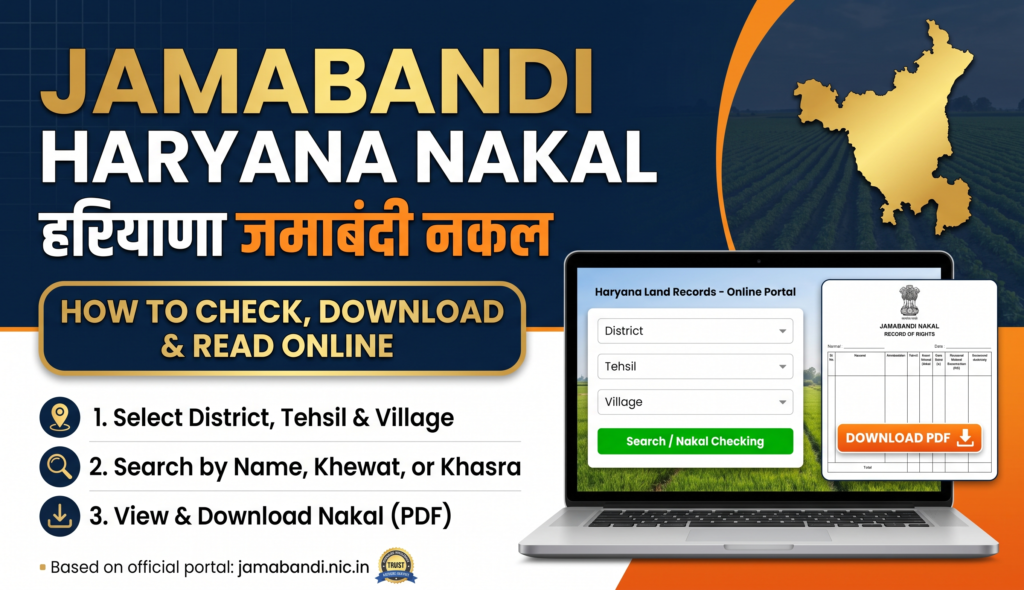
To check a Jamabandi Haryana Nakal, open jamabandi.nic.in, choose Jamabandi Nakal for checking, pick the district, tehsil, village and Jamabandi year, then search by owner name, khewat, khasra or mutation date. Viewing is free. For a copy a bank or registrar will accept, apply for a digitally certified Jamabandi Nakal on the Revenue Haryana portal: ₹100 covers the first 10 pages and each extra page costs ₹5.
What is Jamabandi Haryana?
Jamabandi is Haryana’s Record of Rights: the official revenue record of who owns a piece of land, who cultivates it, how big it is and what rights or charges sit on it. It is kept village by village by the Revenue and Disaster Management Department. The patwari prepares it and a revenue officer attests it.
A fresh Jamabandi is generally prepared about every five years. Sales, inheritance and gifts that happen in between are recorded through mutation (intkal) and noted in the remarks column until the next Jamabandi carries them forward.
Haryana began computerising land records in 1991, with a pilot at Rewari. Today the records sit on jamabandi.nic.in, run by the National Informatics Centre for the Revenue Department. Sub-registrars, banks and courts all treat the Jamabandi as the starting point for land title in Haryana, including in Gurugram.
Jamabandi Nakal, Fard and other Haryana land record terms
A Jamabandi Nakal is a copy of the Jamabandi entry for a particular holding; in everyday Haryana usage it is also called the Fard. The record uses a handful of revenue terms that you will meet on every Nakal.
| Term | What it means | Why it matters to a buyer |
|---|---|---|
| Jamabandi | The full Record of Rights for a village, revised about every five years | The baseline for who legally holds the land |
| Nakal / Fard | A copy of the Jamabandi for one holding | The document you check, and the one a bank or registrar asks for |
| Khewat number | The ownership account: the owner or group of co-owners of a holding | Shows every co-owner whose consent a sale needs |
| Khatoni number | The cultivation account under a khewat | Shows who is in possession or farming the land |
| Khasra / killa number | The number of a specific plot (field) within the village | Ties the paper record to a physical plot; must match the sale deed |
| Hadbast number | The village boundary number | Confirms you are looking at the right village |
| Intkal (mutation) | The entry that updates the record after a sale, gift or inheritance | Until it is sanctioned, the new owner’s name may not show in the ownership column |
| Fard Badr | A correction of a mistake in the revenue record | Look for it if names or areas changed between two Jamabandis |
How to check Jamabandi Haryana Nakal online on jamabandi.nic.in
Checking a Haryana Jamabandi Nakal online takes a few minutes, needs no login and costs nothing. Keep the district, tehsil and village name ready, plus at least one of these: the owner’s name, the khewat number or the khasra number. Menu labels on the portal change from time to time, so look for the closest match.
- Open jamabandi.nic.in, the official Haryana land records portal.
- In the top menu, open Jamabandi Nakal and choose Jamabandi Nakal for checking.
- Select the district, tehsil and village, then the Jamabandi year. Pick the latest year unless you are tracing history.
- Choose how to search: by owner name, by khewat number, by khasra (survey) number, or by date of mutation.
- Enter or pick the detail from the list. For an owner-name search, select the right name, since many villages have several people with the same name.
- Read the Jamabandi Nakal on screen and save it with your browser’s print or save-as-PDF option.
This online copy is for reference. It shows what the revenue record says today, but a bank, court or sub-registrar will usually want a certified copy, covered next.
How to get a certified Jamabandi Nakal online
Since July 2026, Haryana issues digitally certified copies of the Jamabandi Nakal and related land records online through the Revenue Haryana portal, so you no longer have to queue at the tehsil. The process, as announced by the Revenue and Disaster Management Department:
- Log in to the Revenue Haryana portal with your registered mobile number and the OTP sent to it.
- Select the document you need (Jamabandi, mutation, registered sale deed or Fard Badr) and enter the district, tehsil and village.
- Submit the application. You get a unique tracking ID, and the request goes electronically to the patwari or revenue official concerned for verification.
- Once it is approved, pay the fee online.
- Download the digitally certified copy from your dashboard.
| Certified document | Fee |
|---|---|
| Jamabandi | ₹100 for the first 10 pages, then ₹5 per extra page |
| Mutation (intkal) | ₹100, whatever the length |
| Registered sale deed | ₹100, whatever the length |
| Fard Badr | ₹100, whatever the length |
A Jamabandi for a large village can run long, so a 14-page Nakal would cost ₹120 (₹100 plus four pages at ₹5). The jamabandi.nic.in portal also has a Get verifiable copy of Nakal option for registered users, and the Fard centre at your tehsil still issues certified copies over the counter.
How to read a Jamabandi Nakal: the 12 columns
A Haryana Jamabandi Nakal has 12 columns, and for a buyer four of them carry most of the weight: column 4 (owners and shares), column 7 (khasra), column 8 (area and land type) and column 12 (remarks). Start at the header, which prints the Hadbast number, the Jamabandi year, the village, tehsil and district. Confirm these before reading anything else.
| Column | What it records | What to check |
|---|---|---|
| 1 | Khewat number (ownership account) | Same khewat as in the seller’s papers |
| 2 | Khatoni number (cultivation account) | Links to the cultivator in column 5 |
| 3 | Patti, taraf or thola (sub-division of the village) | Matches the village part the land is in |
| 4 | Owners, with father’s name and each one’s share | The seller is named here, alone or with every co-owner |
| 5 | Cultivator or person in possession | “Khudkasht va makbooza malkan” means the owners farm it themselves; a tenant name needs explaining |
| 6 | Source of irrigation, such as a well or tubewell | Context only for most urban buyers |
| 7 | Khasra or killa number, often with the murabba (rectangle) | Matches the sale deed and the plot on the ground |
| 8 | Area of each khasra and type of land: chahi (well-irrigated), nehri (canal), barani (rain-fed), gair mumkin (uncultivable or built up) | Area adds up to what you are buying |
| 9 to 11 | Rent and land revenue (lagan) details | Rarely an issue for buyers |
| 12 | Remarks: mutations since the last Jamabandi, mortgages, court orders and stays | Blank, or only entries you can explain. A mutation noted here overrides column 4 |
The last point catches people out. If land changed hands after the Jamabandi year, column 4 still shows the old owner, and the transfer appears only as a mutation entry in column 12. Read both together.
Other Haryana land record services on the Jamabandi portal
The Jamabandi Haryana portal does more than show the Nakal. Before buying a plot or an independent floor, these are the services worth using alongside it.
| Service | What you can check |
|---|---|
| Mutation status and orders | Whether a sale, gift or inheritance has been entered and sanctioned |
| Registered deeds search | Past sale deeds by district, tehsil, registry number, date, deed type, seller or buyer |
| Cadastral map (Bhu Naksha) | The plot’s shape and position, searched by village, khewat or khasra |
| Collector rates | The government minimum value used for stamp duty, by segment and property type |
| Revenue court cases | Case status and orders on land disputes |
| Deed registration appointment | Available slots at your sub-registrar office |
Two 2026 changes affect how these records move. Haryana registers property deeds paperless since 1 November 2025, with digitally signed deeds checked against the land record. In June 2026 the state launched Paperless Registration 2.0 with auto-mutation, which generates the mutation number at the time of registration, so the Jamabandi should catch up with a sale faster than before.
Jamabandi Haryana for Gurugram home buyers: plots, floors and apartments
How much the Jamabandi Haryana Nakal tells you depends on what you are buying in Gurugram. For land or a plot it is the core title check; for an apartment in a licensed project it is a background check on the project land.
- Land, a farmhouse or an old village plot. The Jamabandi is your main title document. The seller must appear in column 4 of the latest Jamabandi, or in a sanctioned mutation in column 12. Every co-owner on the khewat must sign, and the khasra must match the sale deed and the site.
- An apartment or builder floor in a licensed project. Group housing in Gurugram, Smartworld projects included, is built on land licensed by Haryana’s Department of Town and Country Planning (DTCP), and brochures print the licence number. Your name will not usually appear in the Jamabandi. The record shows the land in the name of the landowning or licensee company, and your title comes through the agreement for sale and, later, the registered conveyance deed.
- What to check for a project. Ask for the khasra numbers in the DTCP licence and look them up. Confirm the owner in column 4 matches the licensee or promoter named in the HARERA record, and read column 12 for stays or mortgages. A mortgage to a project lender is common, so ask how it will be released before handover.
- A resale home where possession has started, such as at Smartworld Orchard or Smartworld Gems. Ask for the seller’s registered conveyance deed and the occupation certificate first; the Jamabandi of the underlying land is a secondary check.
For the HARERA side of this check, see our guide on how to verify a HARERA registration in Gurugram.
Common Jamabandi Nakal problems and how to fix them
Most problems with a Haryana Jamabandi Nakal come from timing or spelling, not fraud, but each one needs an answer before you pay.
| Problem | Likely reason | What to do |
|---|---|---|
| Seller’s name is missing from column 4 | The purchase happened after the Jamabandi year | Look for a sanctioned mutation in column 12, or check mutation status on the portal |
| Owner-name search returns nothing | Spelling differs from the record, or the wrong village or year is selected | Search by khewat or khasra instead, or try another spelling |
| Several co-owners on one khewat | Joint or inherited land | Every co-owner must consent and sign; get their shares in writing |
| Area on the Nakal differs from the sale deed | Partial sale, partition, or an error | Ask for the mutation or Fard Badr that explains it; do not round it off |
| Column 12 shows a mortgage, stay or court case | A loan or dispute is attached to the land | Get the release, NOC or court order before any payment |
| Latest Jamabandi year looks old | The next Jamabandi has not been prepared yet | Read recent mutations in column 12 and the mutation records for the gap years |
| Copy handed over by the seller or agent | Could be outdated or altered | Pull your own Nakal from the portal, or apply for a certified copy |
If the record itself is wrong, the correction goes through the tehsil as a Fard Badr. You cannot change the online Nakal directly.
Quick answers on Jamabandi Haryana Nakal
What is a Jamabandi Nakal in Haryana?
A Jamabandi Nakal is a copy of the Jamabandi, Haryana’s Record of Rights, for one landholding. It shows the khewat and khasra numbers, the owners and their shares, the cultivator, the area and type of land, and remarks such as mutations or mortgages. It is also called the Fard.
How can I check Jamabandi Haryana Nakal online for free?
Go to jamabandi.nic.in, open Jamabandi Nakal and choose Jamabandi Nakal for checking. Select the district, tehsil, village and Jamabandi year, then search by owner name, khewat number, khasra number or mutation date. Viewing the Nakal online is free and needs no login.
How do I get a certified Jamabandi Nakal and what does it cost?
Apply on the Revenue Haryana portal after an OTP login with your mobile number. The patwari verifies the request, you pay online, and the digitally certified copy downloads from your dashboard. A certified Jamabandi costs ₹100 for the first 10 pages and ₹5 for each extra page, as announced in July 2026.
Can I search Jamabandi Haryana by owner name?
Yes. The Jamabandi Haryana portal lets you search by owner name once you select the district, tehsil, village and year. Spellings in the record may differ from the one you type, so if nothing comes up, search by khewat or khasra number instead.
Which column of the Jamabandi Nakal shows mutations and mortgages?
Column 12, the remarks column. It records mutations made after the Jamabandi year, mortgages, court orders and stays. If a mutation is noted there, it overrides the owner shown in column 4, so always read the two columns together.
How often is the Jamabandi updated in Haryana?
A fresh Jamabandi is generally prepared about every five years by the patwari and attested by a revenue officer. Changes in between are entered through mutation. Since June 2026, auto-mutation generates the mutation number at the time of registration, which should shorten the delay.
Do I need a Jamabandi Nakal to buy a flat in Gurugram?
Not for your own title: an apartment buyer’s rights come from the agreement for sale and the registered conveyance deed. It is still worth checking the Jamabandi of the project land to confirm it stands in the licensee or promoter’s name and has no stays. For land or a plot, the Jamabandi is essential.
Is the online Jamabandi Nakal legally valid?
The copy you view on jamabandi.nic.in is for reference. Banks, courts and sub-registrars usually ask for a certified Jamabandi Nakal, which you can now get as a digitally certified copy online or from the Fard centre at the tehsil.
Want help reading the land and licence papers for a Smartworld project you are considering? Request a call back and we will walk you through them.
This article is general information for home buyers, not legal, tax or investment advice. Portal menus, fees and rules change; check the current position with the Haryana Revenue Department and a qualified professional before you act.
This article is general information for home buyers, not legal, tax or investment advice. Rules and portal layouts change; check the current position with HARERA and a qualified professional.